




The new income tax rules 2026 mark the most significant structural change to India's tax framework in over six decades. For businesses operating across Delhi, Mumbai, and Bangalore, this is not just a rate adjustment. The legislative foundation has changed, with the Income Tax Act, 1961, replaced by the Income Tax Act, 2025, effective 1 April 2026. The rates across most categories carry forward, but the section references, form numbers, and filing codes have been completely overhauled.
What Changed and Why It Matters
The government has restructured the TDS and TCS framework under the updated Income Tax Act. Legacy sections carried decades of accumulated confusion and were a steady source of litigation between deductors and the tax department. The new tax rules, effective April 2026, replace that framework with a cleaner numbering system and significantly lower rates for professional and technical services.
The stated aim is practical. Reduce the volume of refund claims, unlock working capital that was previously frozen in tax credit balances, and shift verification to automated, AI-driven systems that limit discretion at the Assessing Officer level.
For a read on how TCS rates for education and travel changed alongside this, see the TCS reductions analysis for Budget 2026.
The New Rate Structure at a Glance
These rates apply to all payments made or credited on or after 1 April 2026. The trigger remains "credit or payment, whichever is earlier."
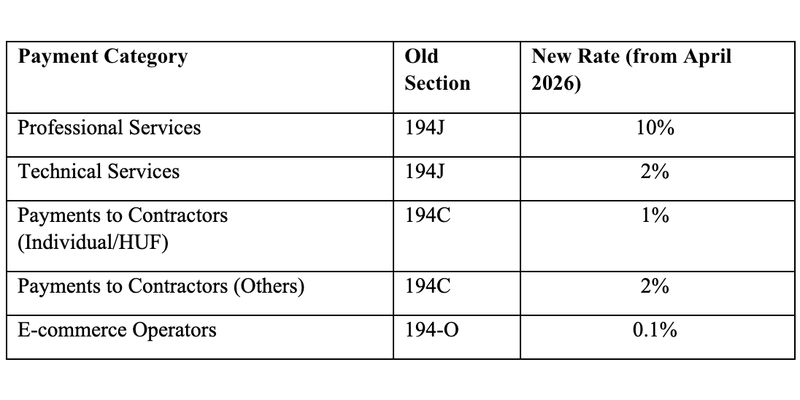
The distinction between professional services and technical services matters more than ever now. Professional fees paid to lawyers, doctors, chartered accountants, and architects attract 10%. Technical and managerial services attract 2%. Getting this classification wrong is one of the most common short deduction triggers the department pursues.
The reasoning behind this direction is explored in the Tiger Global Verdict 2026, which reflects the broader judicial move toward substance over procedural complexity.
Three Situations Where Benefits Get Denied
Lower rates do not apply automatically in every situation. The tax department can and does challenge deductions under these conditions.
- Wrong section code: Using a pre-2026 section number for a payment made after April 2026 is treated as incorrect reporting. The rate applied at source becomes irrelevant if the section mapping is wrong.
- PAN not linked to Aadhaar: If the deductee's PAN is inoperative, the higher rate of 20% still applies regardless of what the new schedule says. Bulk PAN verification before making payments is now essential hygiene.
- Rate applied to the wrong category: Applying a 1% contractor rate to a payment that properly falls under a 10% category means a short deduction. The deductor remains liable for the shortfall plus interest, even if the recipient has already paid the tax separately.
All three expose the deductor to disallowance under Section 40(a)(ia), which can materially increase taxable income.
Income Tax Compliance Checklist 2026
These five steps address the most common failure points in early implementation.
- Update vendor masters. Every vendor record in your ERP needs the correct new section code before the first payment post April 2026. Retroactive corrections are possible but expensive.
- Run bulk PAN verification. Use the Income Tax Department's bulk tool. Any inoperative PAN means you must deduct at 20%, not the new reduced rate.
- Review technical service contracts. Determine whether each contract qualifies for the new 2% rate or still attracts a higher rate under the updated schedule.
- Update accounting software. Configure systems for the new section codes and rates. This includes the TCS reductions under April 2026 that affect procurement and sales workflows.
- Reconcile 26AS and AIS monthly. The Annual Information Statement will surface mismatches early. Catching them before a notice arrives is far cheaper than responding to a defective return query.
Income Tax Changes FY 2026-27 For Real Estate and Salaries
The rate changes for professional and contractor payments get the most attention, but two other areas require recalibration before the financial year begins.
TDS on immovable property sales continues at 1% where the transaction value exceeds Rs. 50 lakh. If your business buys or sells real estate, the updated threshold figures and section references need to be reflected in agreements before execution.
Payroll teams need to revisit salary TDS slabs. The income tax changes FY 2026-27 include updated slab thresholds that affect monthly deduction calculations, particularly for mid-senior employees whose total compensation crosses the revised bracket boundaries.
Lower TDS certificates are now automated
One genuinely useful operational change is the move to a rule-based, automated process for obtaining Nil or Lower TDS certificates. The system reduces dependence on individual Assessing Officers, which historically introduced delays and inconsistent outcomes.
To apply, you generally need a valid PAN, projected financial statements for the relevant period, and a digital declaration of tax liability submitted through the authorized portal. Processing timelines are expected to be significantly shorter than the previous manual route.
Frequently Asked Questions
1. In simple terms, what are the new income tax rules 2026?
The government has renumbered TDS sections and lowered rates for most technical services to 2%, while professional services stay at 10%. Contractor payments at 1% or 2%, depending on entity type, and e-commerce operator deductions at 0.1%. The aim is to reduce refund volumes and free up working capital.
2. Can a lower rate be denied even if the recipient already paid the tax?
Yes. If the deduction was made under the wrong section or at an incorrect rate, the deductor remains liable for interest and penalties. The fact that tax was ultimately paid by the recipient does not extinguish the deductor's obligation.
3. What documents are needed for the new automated Lower TDS certificate?
A valid PAN, projected financial statements showing estimated tax liability for the year, and a digital declaration submitted through the authorized portal are the standard requirements.
4. What are the penalties for using old section numbers after April 1, 2026?
Incorrect section mapping can trigger defective return notices, interest at 1% to 1.5% per month on the shortfall, and potential disallowance of the related business expenditure under Section 40(a)(ia).
Getting ready before April 2026
The new tax rules April 2026 take effect immediately for all payments made on or after that date. There is no grace period for businesses that file on the old section codes. ERP updates, vendor master reviews, PAN verification runs, and payroll recalibration all require lead time that most businesses are already running short on.
Whether you need an income tax lawyer near Delhi, a tax consultant near Mumbai, or a business tax lawyer in Bangalore to handle the implementation or defend a challenge, the team at Commercial Law Chamber provides advisory and litigation support across all major hubs.
For a full TDS health check or to confirm your systems are ready for audit, visit the practice area overview or review the official guidance at the Income Tax Department of India.