



The changeover to the new financial year on 1 April 2026 is a major development in India's fiscal landscape. The government, through the full rollout of the Income Tax Act, 2026 framework, has introduced in a stricter compliance system that aims at curbing tax evasion and enforcing time-bound reporting.
This new system moves away from the old predominantly enforcement-oriented method of tax collection in favour of a digital model of deterrence, where AI-assisted data matching and automated notices identify discrepancies at an early stage itself. Taxpayers in major cities like Delhi, Mumbai, and Bengaluru are in a scenario where even minor mistakes and delays can lead to higher financial penalties as compared to the past.
Old vs New Penalty Framework
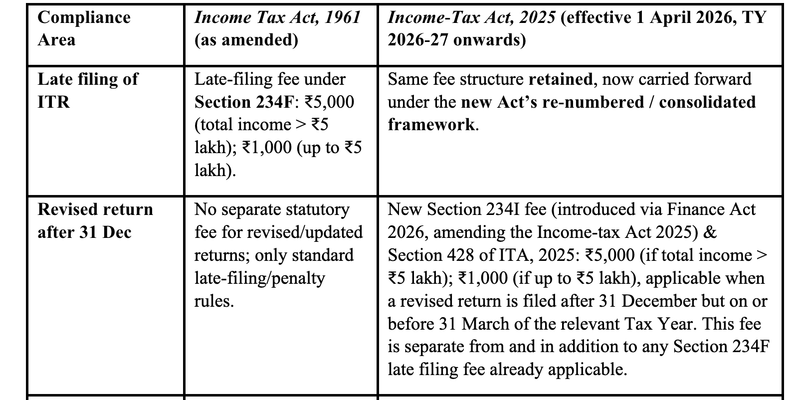
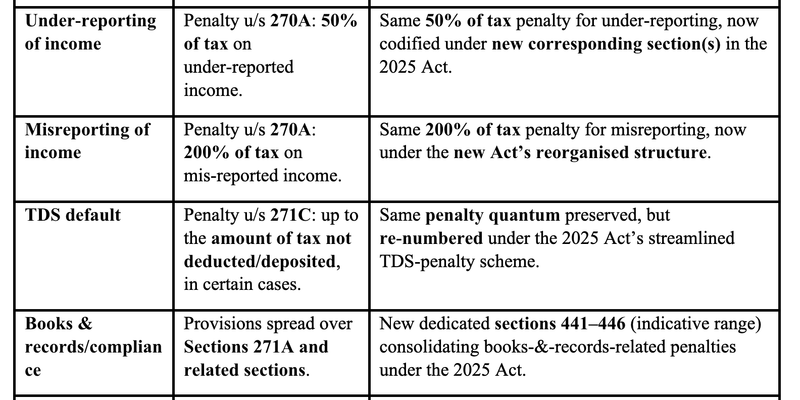
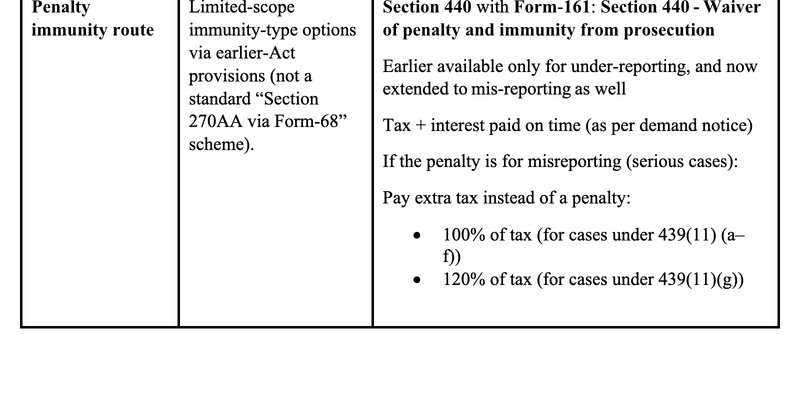
What are the new penalty provisions under the IncomeTax Act, 2025?
These new rules lay down a graduated ladder of fines in case of non-adherence. The 2025 Act has simplified the penalty structure for the "under-reporting" and "misreporting" of income. That is, it clarifies the distinction between the two while enabling more prompt imposition of penalties.
The Assessing Officer can levy penalties under the new law from 1 April 2026 after the automated detection of mismatches (AIS-/26AS-based data-matching); the final order, however, is still made by the officer, not by a fully independent AI system. Simply put, the Faceless / e-assessment system serves primarily as a trigger for notices, while the officer-based statutory framework controls the actual penalty orders.
Updated Return Penalty Rates & Revised Return Rules
The Finance Act, 2026, which is the amendment act to the Income-tax Act 2025, has brought in an important change with regard to revised returns. Taxpayers were allowed to file revised returns up to 31 December of the Assessment Year as per the Income-tax Act 1961. The Finance Act, 2026 has increased this time limit to 31 March, but introduces an additional burden: any revised return filed after 31 December is liable to a fee under the newly introduced Section 234I. This charge is apart from the Section 234F late filing fee and taxpayers maybe subject to both at the same time.
If an updated tax return is submitted after Dec 31 but on or before March 31, the flat charges will be
- ₹ 5,000 (if total income is more than ₹ 5 lakh), or
- ₹ 1,000 (if total income is ₹ 5 lakh or less)
Solely for this reason, SMEs and corporates, whose financial statements are usually audited and closed by year-end, need to take this into consideration very seriously. The main aim is to avert the "submit now, rectify later" approach that used to create a backlog for the revenue department.
When Do These Penalties Apply?
The Income‑Tax Act, 2025 introduces stricter penalty rules for Tax Year 2026‑27 onwards.:
- Inaccurate Particulars: Providing false information regarding deductions or exemptions.
- Default in TDS/TCS: Delays in depositing tax collected at source.
- Non-Response to Notices: Failure to comply with a statutory notice within the stipulated window (generally 15 to 30 days).
For a deeper dive into how technicalities can sometimes lead to unfair penalties, see our reflection on when technicalities mask justice.
Step-by-Step Risk Mitigation Checklist
To avoid these steep fines, the Commercial Law Chamber recommends the following protocol:
- Quarterly Reconciliations: Do not wait until March 31. Reconcile books with 26AS/AIS every 90 days.
- Verify Supplier Compliance: Ensure your vendors are filing their returns to avoid ITC blocks.
- Document Every Deduction: Maintain a digital trail for all high-value exemptions claimed.
- Early Filing: Aim to file at least 30 days before the deadline to accommodate system glitches.
Impact on Salaried, SMEs & Corporates Across Cities
- Salaried Professionals (Delhi/Bangalore): There will be tougher checks on HRA and LTA allowances. Any incorrect reporting in these cases will now involve under‑reporting or misreporting penalties (50% or 200% of tax, as applicable) rather than mere disallowance.
- SMEs (Mumbai): The additional "Correction Fee" on changing returns may strain cash flows cash for companies that depend on the end of the financial year audits for deciding final figures.
- Corporations: Apart from adjusting to the reduction in the MAT rate to 14%, they must ensure that positions taken do not amount to misreporting ,
Legal Interpretation & Judicial Reasoning
In India, courts, including the Delhi and Bombay High Courts, have for a long time considered that "penalty is not a matter of course." The law on Income Tax, 2025, does not materially alter this principle, but it definitely reforms the evidential framework and also broadens the immunity-based exit routes in some respects.
For cases of under-reporting or misreporting, Section 440, accompanied by Form-161, provides a legal channel through which the taxpayer can opt out of both penalty and prosecution risks if he/she:
- Admits the assessment/reassessment order,
- Makes complete payment of tax and interest within the time limit,
- Does not and shall not file an appeal,
- Submits Form-161 within a month of the order.
This is not a discretion-based relief; it is a statutory immunity device which is seldom recognized in practice.
Conclusion
The 2025 Act doesn't reinvent what gets penalised or how much. Instead, it makes the system faster at identifying issues, add a real cost to late revisions through Section 234I, and shorten the window to exit cleanly via immunity. Errors that were earlier corrected informally now carry a clear financial consequence..
If you have received a notice or want to map your exposure before the assessment cycle starts, consulting an income tax lawyer in Delhi, a tax law firm in Mumbai, or a corporate tax advisor in Bengaluru with transition-era experience is the appropriate first step.
For a detailed penalty-risk audit under the 2025 Act, contact the Commercial Law Chamber.
FAQs
1.What is the late filing fee under the 2025 Act?
Rs. 5,000 for income above Rs. 5 lakh, Rs. 1,000 up to Rs. 5 lakh. Nothing below the exemption limit.
2. What is the new fee on revised/updated returns?
Under Section 234I, introduced by Finance Act 2026, a fee of Rs. 5,000 (total income above Rs. 5 lakh) or Rs. 1,000 (total income up to Rs. 5 lakh) applies when a revised return is filed after 31 December but on or before 31 March of the relevant Tax Year. This is separate from the Section 234F late filing fee, and both fees may apply simultaneously if the original return was also filed late.
3.What is the penalty for misreporting?
Under Section 439 of the Income-tax Act 2025 (corresponding to Section 270A of the 1961 Act), the penalty for misreporting is 200% of the tax payable on the misreported income. Underreporting without deliberate falsification attracts 50%. These rates are unchanged from the previous law
4.Which law covers FY 2025-26?
The Income Tax Act, 1961 (as amended), governs the assessment of income earned up to 31 March 2026 (AY 2026‑27). The Income‑Tax Act, 2025, applies to Tax Year 2026‑27 onwards (income earned on or after 1 April 2026).
5.Can penalties be waived?
Yes, mainly in two ways according to the 2025 framework:
- Section 440, along with Form161: Complete immunity by law from penalty and prosecution for underreporting/misreporting provided that tax + interest are paid, no appeal is filed, and Form161 is submitted within one month of the order. In misreporting cases, an additional tax payment is required to claim immunity.
- Section 469: Principal Commissioner has the discretionary authority to lessen or even forgive the penalty (fully or partly) if the taxpayer completely exposes the facts and is helpful in the department's investigation; however, there are certain conditions here.